Why do I need cloud?

Cloud planning board beside server infrastructure

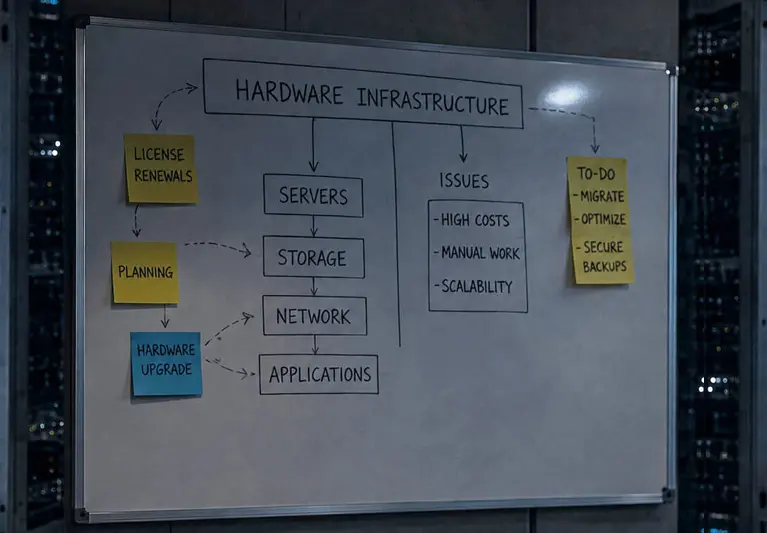
Change is expensive

Traditional infrastructure does not adapt well to change. When you add staff, reorganize teams, or migrate data, you often end up facing licensing fees, hardware purchases, or infrastructure upgrades that were never part of the plan.

Cloud changes that. Instead of large unpredictable expenses, you pay operational costs that scale with your business and are much easier to manage and plan around

Hybrid Work is the new reality

Where and how people work has shifted, and cloud infrastructure is a big part of why. Organizations with strong cloud adoption are less tied to a physical location and more capable of adjusting their capacity without large purchases or drawn out procurement processes.

Dont put all your eggs in one basket

A physical server in your office is only as safe as the building it sits in. Ransomware attacks, Hardware failures, power issues, and physical damage are all real risks, and restoring from a serious incident can be slow and expensive.

Cloud storage spreads your data across multiple secure locations, removing the single point of failure that makes on-site setups vulnerable

Why do i need my cloud managed?

Why cloud management is important?

Cloud management covers everything that keeps your cloud environment running as it should, from performance monitoring and security to resource allocation and cost control.

Without it, cloud environments tend to drift, becoming harder to secure, more expensive to run, and increasingly difficult to scale

Do i need someone to manage my cloud?

Start by taking a clear look at your business priorities and the issues you want to solve, whether that is security, collaboration, cost control, performance, or a combination of both.

Set a budget early and use it to narrow your options. Then focus on providers with the right technical background, along with a communication style and working relationship that fit your team.

When you meet with potential providers, look beyond the sales pitch. Ask how they work, whether they have experience with organizations like yours, and where their responsibilities begin and end.

Before making a final decision, ask your strongest candidates to review your environment and provide a written recommendation. A thoughtful response will quickly show which providers are prepared to deliver real value and which are not.
What is Hybrid Cloud?

Hybrid cloud combines on-site infrastructure with public cloud services, giving organizations the flexibility to run different workloads where they make the most sense.

Sensitive data stays on private infrastructure, while less critical operations take advantage of public cloud scalability and cost efficiency.

The tradeoff is complexity. Managing multiple environments means security, compliance, and costs all need to be tracked across different platforms.

Without the right expertise in place, that complexity tends to compound quietly until it becomes a real operational problem.

Is Cloud suitable for SMB?

Cloud works just as well for a ten person business as it does for a ten thousand person one. For small and medium sized businesses, it levels the playing field, reducing IT costs, improving security, and providing access to infrastructure that scales as the business grows.

Most SMBs do not have dedicated IT staff to manage cloud environments internally, nor should they need to.

Working with an experienced cloud management team gives smaller businesses access to the same capabilities as larger organizations, without the overhead, complexity, or learning curve that comes with managing it on their own

Meet your new leverage

Start a Conversation

We automate architecture deployments using Infrastructure as Code and agentic AI, which means faster rollouts, fewer manual errors, and a leaner environment that costs less to run from day one

The right workload in the right cloud environment costs less to run and performs better. We assess your applications and infrastructure and move what makes sense, so your operational costs reflect what your business actually needs rather than how things were set up by default

When something goes wrong, how fast you recover determines how much it costs. We put disaster recovery solutions in place before you need them, so downtime is measured in minutes rather than days